
Over the past months, I have done dozens of interventions in businesses and organizations: training sessions, team workshops, leadership coaching. SMEs, nonprofits, public bodies. Very different contexts, very different sizes.
And yet, from one intervention to the next, the same picture kept coming back.
AI is already there. It came in through the window rather than the front door: someone tried a tool, saved twenty minutes on an email, mentioned it at the coffee machine. A few months later, half the team uses it, each in their own way. People feel more productive, and they are right. But when I ask leadership what has changed for the people they serve, the answer is almost always the same: not much. Lead times are the same. So is the queue.
What I saw in the field is a problem of focus. AI is working, but not where the service is stuck. This article presents the model I built to answer that. It is called AI Mapping, and its principle fits in four words: from friction to flow.
Three things I saw everywhere
First, AI goes where it is easy to see. Communications, the website, emails. Rarely where work actually gets stuck.
Second, the time saved goes nowhere. Twenty minutes saved by someone who is not the busiest person on the team become twenty minutes of waiting a little further on.
Third, nobody knows where the service is stuck. When I ask a team which single step limits everything, I get as many answers as there are people in the room.
The numbers confirm it. In software development, where AI is most advanced, AI-equipped teams submitted 98% more code. Review time jumped 91%. Organizational delivery stayed flat (Faros, about 10,000 developers).
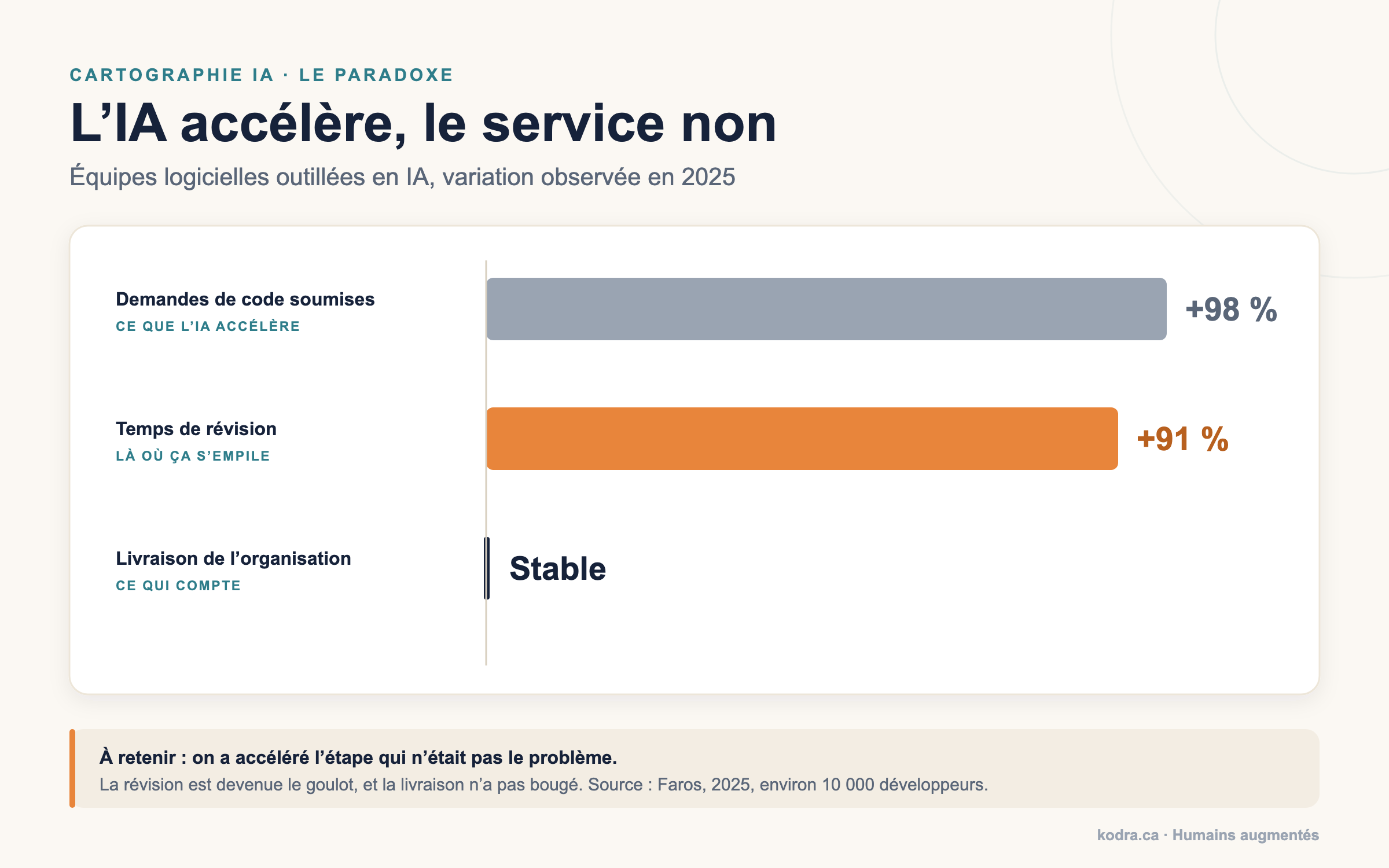
Production sped up. Review became the bottleneck. The end result did not move.
A service moves at the pace of its bottleneck
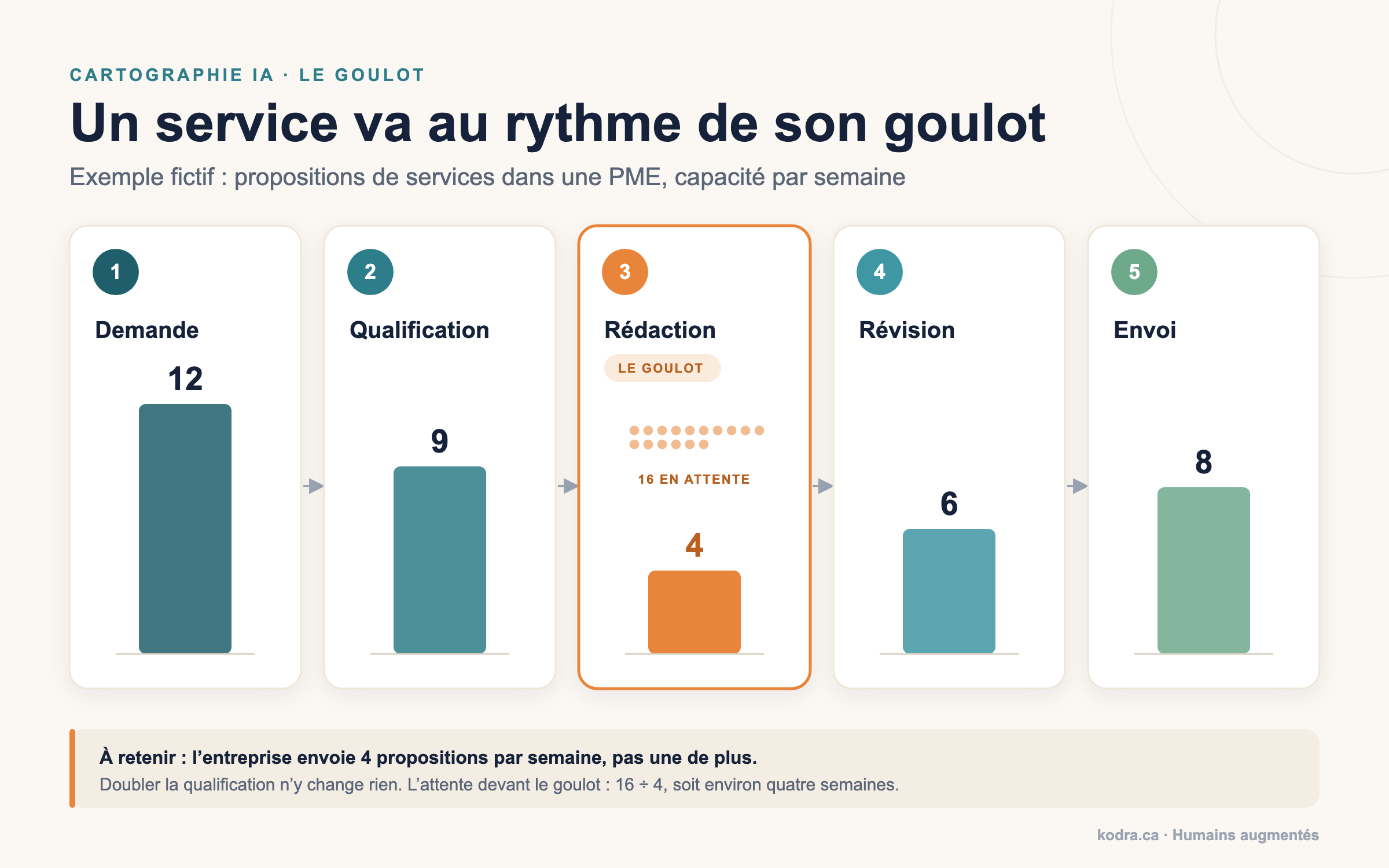
Take a bottle. Pour as fast as you like: the water leaves at the pace of the bottleneck. A service works the same way, and everything is a service: even a product sold first meets a need, and every business has internal services (HR, accounting, marketing, customer service). Every request goes through a series of steps, and one of them limits all the others. This is Eliyahu Goldratt’s Theory of Constraints, and it has four practical consequences.
- An hour saved elsewhere is a mirage. Speeding up a step before the bottleneck only grows the queue.
- The bottleneck is often a rule. A form to complete in full, a mandatory signature, a habit from another era.
- Waiting can be calculated. Little’s law: wait = queue ÷ throughput. Sixteen requests waiting, four proposals written per week: four weeks. Meanwhile, the client signs elsewhere.
- The bottleneck can be demand. If your team is waiting for clients, the constraint is marketing. AI helps there too: preparing a campaign, producing and publishing content, analyzing what attracts clients, following up with prospects. And each flow (selling, delivering, invoicing) has its own bottleneck. The method stays the same: find the bottleneck that limits you today, then apply AI there.
The service blueprint, with a flow layer
Service design gives us the journey map (where it hurts) and the service blueprint (what the organization does internally to deliver each step). Both have a blind spot: time. AI Mapping adds a third layer, the flow: work time, lead time, queue, capacity and rework for each step.
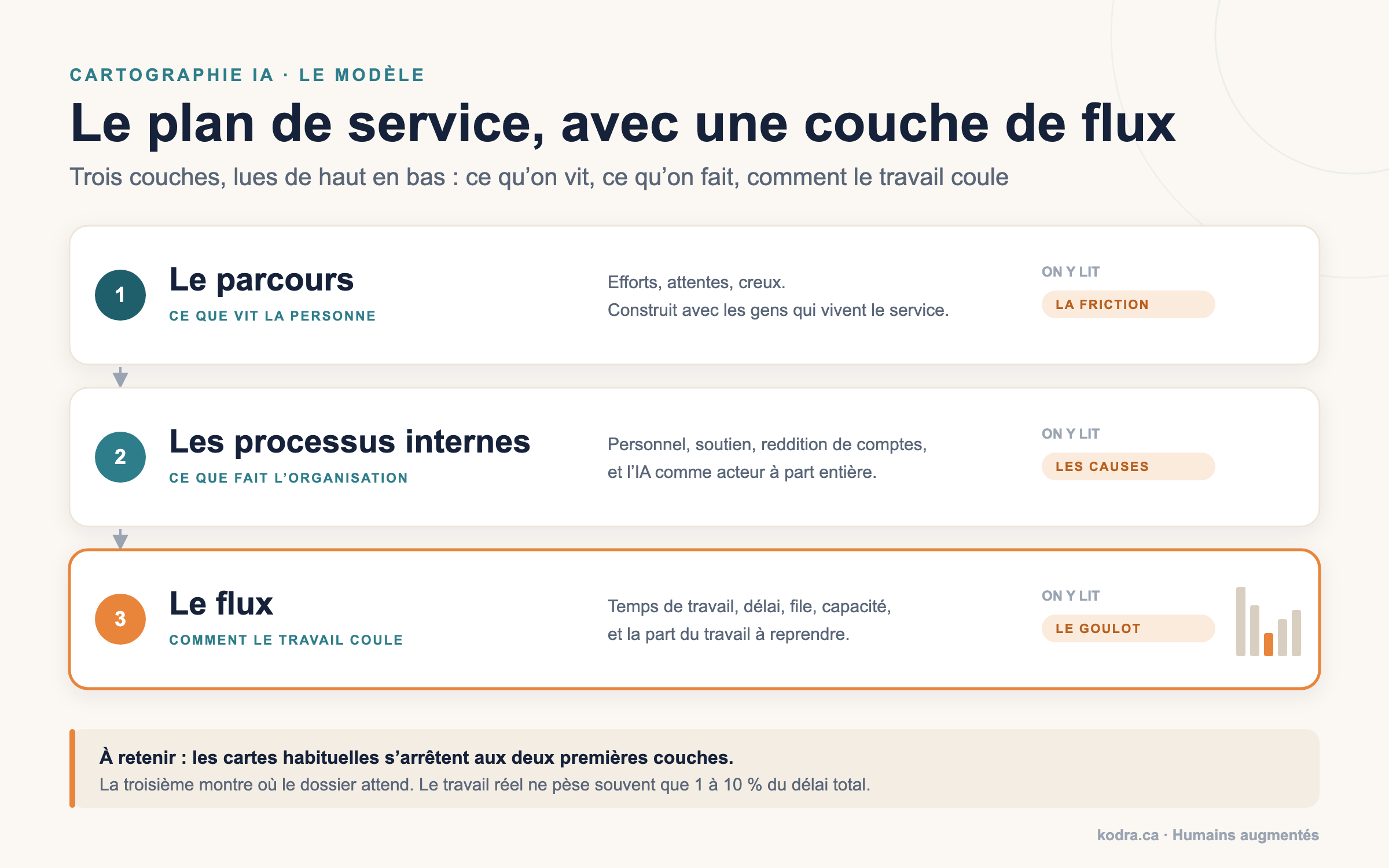
That third layer almost always holds a surprise. In services and offices, the time a file actually moves is typically 1 to 10% of its total lead time (Martin and Osterling, 2013). The rest is waiting.
Change the rule before adding AI
In Utah, workforce services cut decision time from 15 to 11 days by requiring complete files before they reached eligibility workers. In New Zealand, a chemotherapy clinic cut average patient wait from 129 to 16.5 minutes by changing one rule. At Ford, accounts payable (an internal service) shrank by about 75% once the rule changed from paying on invoice to paying on receipt of goods (Hammer, 1990). At IBM Credit, client financing approval went from six days to four hours when one person handled each request from start to finish instead of four specialists in turn (Hammer and Champy, 1993). None of these gains needed AI. When AI comes afterward, it works on a bottleneck already cleared of useless rules.
Five criteria, then a portfolio
Every AI idea passes five criteria, in order: failure (does this demand exist because we failed upstream?), rule (is the bottleneck a rule?), limitation (which limitation does AI reduce at the bottleneck?), frontier (is the task where AI is reliable, and who checks?), and human (does the step decide for the person, or build the relationship?).
The ideas that remain go into a portfolio, on two axes: effect on the bottleneck and relational load.
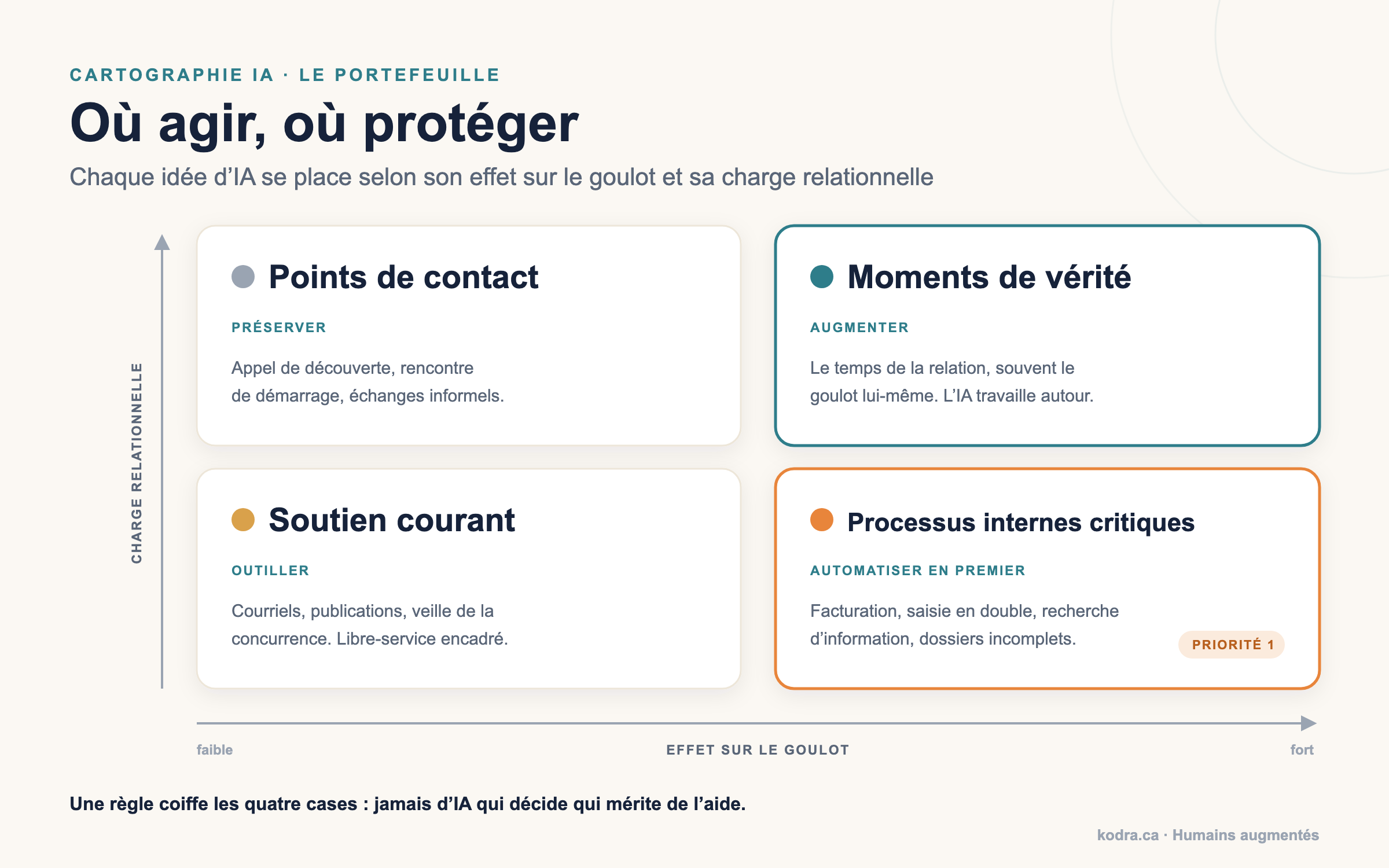
Critical internal processes: automate first. Work the person never sees, but that blocks everything else. Moments of truth: augment, never replace. Relationship time is often the bottleneck itself; AI works around it. Routine support: equip. Self-service, framed by a policy. Touchpoints: preserve. They do not limit throughput, and they bring people back.
And one rule sits above all others: no AI deciding who deserves help.
Where it fits with the AI In-Basket and the AI Canvas
The AI In-Basket helps a person decide what to delegate. The AI Canvas helps design what to build for a process. AI Mapping sits one level up: it looks at the whole service and asks not "what irritates us?" but "what limits everything?". The two answers are not always the same.
The limits, honestly
This is a new approach, still being validated. The stopwatch can hurt: in Quebec’s health network, Lean was sometimes used to compress care. We measure the work, never the people, and freed time has a destination decided with the team. And sometimes the bottleneck is leadership itself.
In short
Not more AI. Not faster. In the right place.
Want to know where your organization’s bottleneck is, and whether AI can really help there? That is exactly the kind of diagnosis we do at KODRA. Write to seb@kodra.ca.